
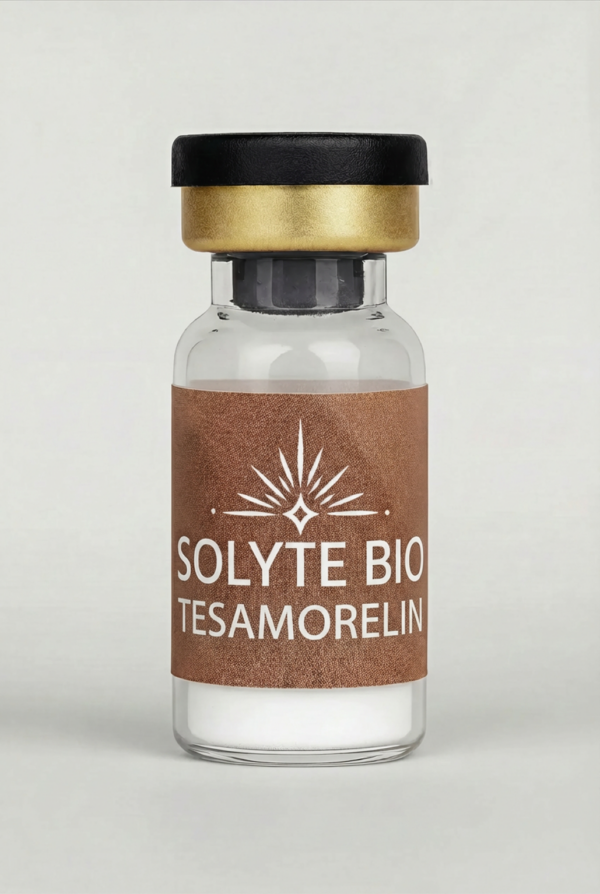
Tesamorelin – Research Use Only
Overview
Tesamorelin is a laboratory-engineered peptide that acts as an analog of Growth Hormone–Releasing Hormone (GHRH). It is widely studied for its ability to stimulate the pituitary gland to release natural growth hormone (GH). Research often explores Tesamorelin’s potential effects on fat metabolism, lean muscle maintenance, and cellular growth, making it a valuable tool in metabolic and endocrine studies.
Background
Tesamorelin is a modified version of the human GHRH(1–44) sequence, designed to be more stable and longer-lasting than the naturally occurring hormone. It binds to GHRH receptors in the pituitary gland, which can increase growth hormone production and raise levels of IGF-1, a key growth-related signaling molecule.
In laboratory settings, Tesamorelin has been used to study:
-
How the body breaks down and uses stored fat
-
How protein synthesis and muscle preservation are regulated
-
How growth hormone pathways impact cellular repair and energy balance
Its stability and strong receptor activity make it a dependable peptide for metabolic and hormonal research models.
Common Research Uses
-
Studying GH and IGF-1 signaling pathways
-
Exploring lipid metabolism and energy regulation
-
Investigating cell repair and anabolic response mechanisms
Product Specifications
-
Sequence: Tyr–Ala–Asp–Ala–Ile–Phe–Thr–Asn–Ser–Tyr–Arg–Lys–Val–Leu–Gly–Gln–Leu–Ser–Ala–Arg–Lys–Leu–Leu–Gln–Asp–Ile–Met–Ser–Arg–Gln–Gln–Gly–Glu–Ser–Asn–Gln–Glu–Arg–Gly–Ala–Arg–Ala–Arg–Leu–NH₂
-
Molecular Formula: C₂₂₁H₃₆₆N₇₂O₆₇S
-
Form: Lyophilized powder
-
Purity: ≥ 99% (HPLC)
-
Storage: –20 °C (long-term)
-
Solubility: Sterile water or acetic acid (research-grade only)

Reviews
There are no reviews yet.